
| Metric | Value |
|---|---|
| Price (JPY) | Y4,868 |
| Dividend Yield | 2.63% |
| P/E Ratio (TTM) | 23.2x |
| Market Cap | Y17.8t |
| 52-Week Range | Y3,088 – Y6,012 |
Educational research only, not investment advice. Market data changes frequently. See the full Disclaimer.
Data freshness: Market prices, yields, valuation multiples, and forecasts in this article are dated snapshots rather than live quotes. Page maintenance review: July 10, 2026. Verify current quotes and the latest official IR guidance before making a decision.
Disclosure: This article contains affiliate links to TradingView. We may earn a commission at no extra cost to you.
¥1 trillion buyback. 318 million shares cancelled. FY2026 net income guided at ¥1.1T — a 37% recovery. Yet the English-language IR summary for Mitsubishi Corp (8058) omits the segment-level ¥-denominated capital targets buried in the Japanese medium-term management plan (中期経営計画).
That gap between what domestic analysts are watching and what US investors are working from is exactly what this article resolves.
Investment Thesis
Author’s View: Constructive | Fair Value Estimate (Author’s Model): ¥5,500 (thesis-based) | Data snapshot: May 2026; page maintenance review: July 10, 2026
- Core thesis: Completed ¥1 trillion buyback (318M shares cancelled) plus FY2026 net income guidance of ¥1.1 trillion creates a dual catalyst — EPS accretion locked in, growth optionality building — that peers Itochu and Mitsui cannot replicate simultaneously at this scale.
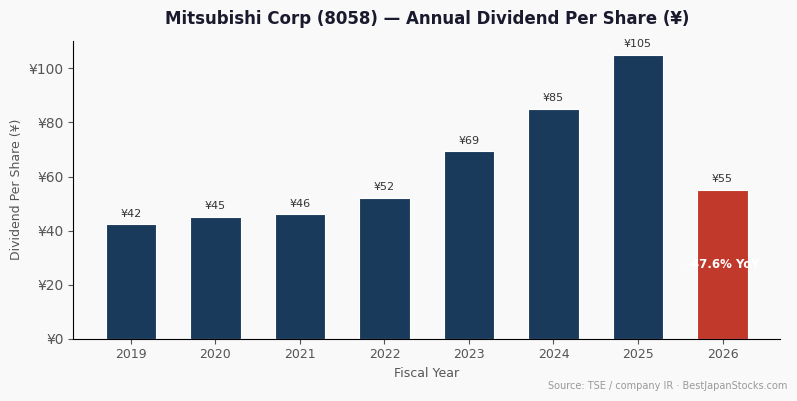
- Numeric backing: Dividend raised to ¥125/share for FY2026 (from ¥55 prior year); PER 25.65x; OpenWork employee score 4.37/5.0 (top-ranked for mutual respect) signals management quality; Minkabu (みんかぶ) consensus: 4 strongly constructive view, 2 Buy, 7 Neutral, 1 Sell — average fair-value estimate ¥5,209.
- Top risk: Commodity price downturn — particularly LNG and copper — could compress Natural Gas and Mineral Resources segment earnings, which together anchor the bull case.
| Metric | Value |
|---|---|
| Stock Price (JPY) | ¥5,432 (May 22, 2026) |
| Market Cap | ¥20.08 trillion (~$125B USD) |
| Dividend Yield | 2.03% |
| Forward Dividend (FY2026) | ¥125/share |
| P/E Ratio (TTM) | 25.65x |
| P/B Ratio | 2.11–2.13x |
| Payout Ratio (approx.) | ~26% (forward) |
| 52-Week Range | ¥3,900 – ¥5,700 (approx.) |
| TSE Listing | Prime Market (8058) |
| ADR Ticker (OTC) | MTSUY |
Before proceeding, please read the full Disclaimer. Nothing here constitutes personalized investment advice. The author does not currently hold positions in securities discussed.
Mitsubishi Corporation (TSE: 8058) is Japan’s largest sogo shosha by market capitalization — approximately ¥20 trillion as of May 2026. Yet for most English-language investors, the stock remains a black box.
It is too diversified to model cleanly, too Japan-specific to fit neatly into a Western sector framework, and too often summarized with a single line about Warren Buffett’s stake.
This article cuts through that noise. It maps the ten-segment business model, resolves valuation discrepancies that confuse even experienced analysts, details catalysts already in motion, and surfaces Japan-specific dynamics that English-only coverage consistently misses.
What Is a Sogo Shosha — and Why Does It Matter for US Investors?
A sogo shosha (総合商社) is a uniquely Japanese institution: a diversified trading conglomerate that simultaneously operates as a commodity trader, infrastructure investor, and industrial holding company.
Western analysts frequently misprice these companies because standard DCF models miss equity-method earnings — profits from affiliated companies that flow through the income statement but are invisible in revenue line items.
For US dividend investors, the practical implication is this: the dividend yield you see on a screener understates the total earnings power of the business. Mitsubishi’s ~26% forward payout ratio leaves significant headroom for progressive dividend increases — a key attraction for income-oriented portfolios.
Mitsubishi Corp operates across ten diversified segments: Natural Gas, Comprehensive Materials, Chemical Solutions, Metal Resources, Industrial Infrastructure, Automobile and Mobility, Food Industry, Consumer Industry, Electric Power Solution, and Complex Urban Development.
No single commodity or sector dominates. That diversification is the structural moat — and the source of persistent analytical confusion for foreign investors.
| Metric | Value |
|---|---|
| Price (JPY) | Y4,457 |
| Dividend Yield | 2.85% |
| P/E Ratio (TTM) | 21.3x |
| Market Cap | Y16.3t |
| 52-Week Range | Y2,837 – Y6,012 |
The ¥1 Trillion Buyback: What It Actually Means
Mitsubishi completed its ¥1 trillion share buyback program on March 25, 2026, cancelling approximately 318 million shares.
The mechanical effect is straightforward: fewer shares outstanding means higher earnings per share, even if net income stays flat. This is EPS accretion that is already locked in — it does not depend on commodity prices recovering or new investments paying off.
For dividend investors, the buyback also reduces the absolute dividend payout required to maintain or grow per-share dividends. Management has already guided the FY2026 dividend to ¥125/share — a significant step up from prior levels — consistent with this improved capital efficiency.
The TSE’s ongoing push for PBR improvement and capital efficiency has clearly influenced this decision. Mitsubishi’s PBR of 2.11–2.13x means it is not on the TSE watchlist — but the buyback signals proactive governance alignment, not reactive compliance. You can review the company’s TSE governance disclosures via JPX’s listing portal.
Corporate Strategy 2027: Where the ¥ Is Going
Mitsubishi’s Corporate Strategy 2027 commits approximately $25.5 billion in capital deployment across the plan period. The highest-conviction allocations are in Natural Gas and Mineral Resources.
This matters for US investors because it telegraphs where management expects the most durable earnings growth. Natural Gas exposure includes LNG infrastructure — a segment with long-term contracted cash flows, not just spot-price speculation.
In May 2026, Mitsubishi secured a major turbine delivery for the US$7 billion Cheyenne Power Hub in Wyoming — a concrete example of its large-scale gas power technology generating real US-dollar revenue. Full IR details are available via Mitsubishi Corp’s English IR page.
On the metals side, Australia-Japan critical minerals cooperation — reported by Reuters in May 2026 — directly benefits Mitsubishi’s Metal Resources segment, which has copper exposure that Morningstar projects could drive a 37% surge in FY2026 net income.
The company’s Japanese-language medium-term management plan (中期経営計画) contains segment-level ¥-denominated capital targets that the English summary does not fully replicate. Investors who rely solely on English IR materials are working from an incomplete picture. Access the full Japanese filings via EDINET.
FY2025 Results and FY2026 Guidance: The Numbers That Matter
For the fiscal year ending March 2026 (FY2025 in Japanese reporting convention), Mitsubishi reported:
- Revenue: ¥19 trillion (up 1.6% YoY)
- Net income: ¥800.5 billion (down 16% YoY)
- EPS: ¥211 (down from ¥237 prior year)
The net income decline reflects commodity price normalization — not structural deterioration. Management’s FY2026 guidance of ¥1.1 trillion net income represents a 37% recovery, supported by copper price tailwinds and favorable FX.
The forward dividend of ¥125/share implies a payout ratio of approximately 26% on guided earnings — leaving substantial retained earnings for reinvestment and further shareholder returns. Verify the latest quarterly filings directly on Mitsubishi’s Japanese IR page (三菱商事 IR).
Japan Edge: Local Intelligence US Investors Are Missing
This is where the blog’s Japan-based perspective adds genuine value — data points that US-only investors cannot easily access.
OpenWork Employee Score: Mitsubishi Corp scores 4.37 out of 5.0 on OpenWork.jp, Japan’s leading employee review platform. It ranks 1st for “Employee Mutual Respect” and 3rd for both “Treatment Satisfaction” and “Employee Morale.”
Why does this matter for dividend investors? A 4.37/5.0 score at a company of 62,000+ employees signals institutional stability and low management-culture risk — factors that correlate with consistent capital allocation discipline and lower earnings volatility over multi-year horizons.
Minkabu (みんかぶ) Analyst Consensus: As of May 23, 2026, the consensus on Minkabu (みんかぶ) shows 4 strongly constructive view, 2 Buy, 7 Neutral, 1 Sell, with an average analyst fair-value estimate of ¥5,209 — implying approximately -4% downside from the May 22 price of ¥5,432.
The Minkabu (みんかぶ) AI diagnosis rates 8058 as “undervalued” on relative comparison but “overvalued” on historical comparison — a nuanced split that suggests the stock is fairly priced relative to peers but stretched versus its own history.
Domestic retail investor sentiment showed “buying forecast increasing” (ranked 4th) on May 20, indicating dip-buying interest from Japanese retail investors who know this company well.
For US investors, this split consensus is actually informative: it confirms that the current price is not a screaming bargain, but the forward earnings recovery to ¥1.1 trillion net income could re-rate the stock toward ¥5,500+ if commodity prices cooperate.
Warren Buffett’s Stake: Context Without Hype
Berkshire Hathaway holds approximately 9.67% of Mitsubishi Corporation — a position that has been widely reported and is a matter of public record via regulatory filings.
Buffett’s investment in the five major sogo shosha is consistent with his stated preference for businesses with durable competitive advantages, strong cash generation, and management that allocates capital rationally. Mitsubishi’s completed buyback and progressive dividend policy fit that pattern.
What the Buffett angle does not tell you: whether Berkshire will increase its stake, hold steady, or eventually reduce it. That is unknowable from public information.
This remains pure pattern-matching observation. I have no insider knowledge of Berkshire’s intentions. Investors should not buy 8058 on the assumption that Berkshire will take any specific future action.
Passive Income Potential for US Investors
At the FY2026 guided dividend of ¥125/share and a price of approximately ¥5,432, the forward yield is approximately 2.3%. The table below illustrates potential annual income at various position sizes, using a ¥150/$ exchange rate for illustration.
| Investment Size (USD) | Approx. Shares | Est. Annual Dividend (USD, pre-tax) | After 15.315% Withholding |
|---|---|---|---|
| $5,000 | ~55 shares | ~$46 | ~$39 |
| $10,000 | ~110 shares | ~$92 | ~$78 |
| $25,000 | ~275 shares | ~$229 | ~$195 |
| $50,000 | ~550 shares | ~$458 | ~$389 |
Estimates for illustration only. Assumes ¥150/$ exchange rate, ¥125/share FY2026 guided dividend, 15.315% Japanese withholding tax under US-Japan treaty. Minimum purchase lot on TSE is 100 shares. Actual income varies with FX, declared dividend, and broker fees. Dividends are typically paid semi-annually.
Peer Comparison: How 8058 Stacks Up
| Company | Ticker | Market Cap (¥T) | Fwd Dividend Yield (approx.) | Key Differentiator |
|---|---|---|---|---|
| Mitsubishi Corp | 8058 | ~¥20T | ~2.3% | Largest sogo shosha; LNG + copper exposure; ¥1T buyback complete |
| Mitsui & Co | 8031 | ~¥9T | ~3.5% | Strong resource diversification; Buffett stake also held |
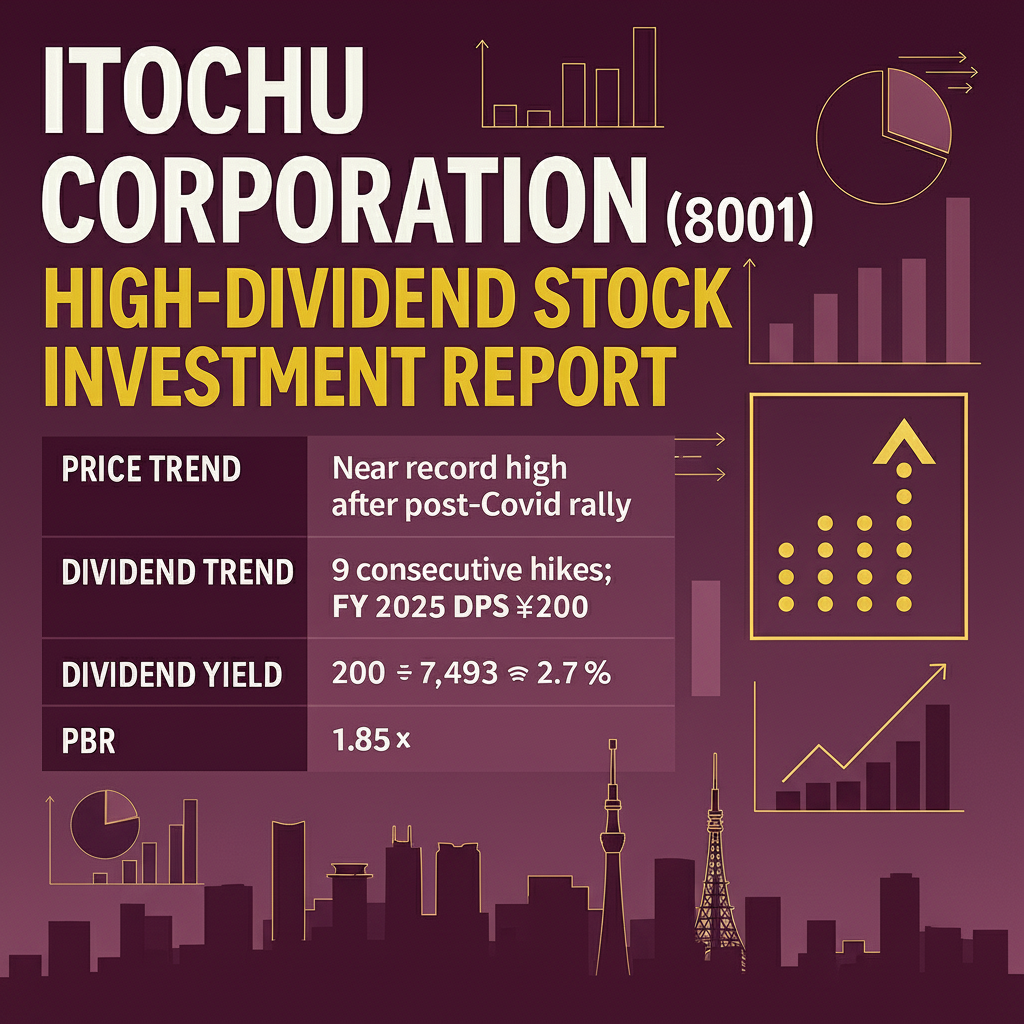
| Itochu Corp | 8001 | ~¥11T | ~2.5% | Consumer-heavy mix; lower commodity cyclicality |
| Sumitomo Corp | 8053 | ~¥5T | ~3.2% | Metal products + media/digital exposure |
Mitsubishi’s lower yield relative to Mitsui and Sumitomo reflects its premium valuation — the market is pricing in the earnings recovery and buyback-driven EPS accretion. Income-focused investors who prioritize current yield may prefer Mitsui; total-return investors may find Mitsubishi’s forward earnings trajectory more compelling.
Risks and Counter-View
A constructive view on 8058 requires honest engagement with the bear case. Here are the three most substantive counterpoints:
1. Commodity price cyclicality. Natural Gas and Mineral Resources are the highest-conviction segments in Corporate Strategy 2027. If LNG prices soften further or copper retreats from current levels, the FY2026 ¥1.1 trillion net income guidance could prove optimistic. FY2025’s 16% net income decline is a recent reminder of this exposure.
2. JPY/USD currency risk. US investors receive dividends in yen. A strengthening yen benefits USD-based returns; a weakening yen erodes them. Japan’s 10-year yield near a 30-year high introduces additional macro uncertainty around the yen’s trajectory. This is a structural risk that does not disappear with a strong fundamental thesis.
3. Valuation is not cheap on historical metrics. At PER 25.65x and PBR 2.11x, Mitsubishi is priced for recovery. The Minkabu (みんかぶ) AI diagnosis flags “overvalued” on a historical comparison basis. If the FY2026 earnings recovery disappoints — due to commodity headwinds or FX — the current valuation offers limited margin of safety.
4. Complexity discount is structural. The ten-segment model means no single analyst can model all moving parts with precision. This creates persistent valuation uncertainty — which cuts both ways, but creates downside risk if sentiment shifts.
Bottom Line — Author’s View: Constructive on 8058 for 2026
Mitsubishi Corp is not a screaming value play at ¥5,432 and PER 25.65x. The Minkabu (みんかぶ) consensus fair-value estimate of ¥5,209 implies the stock is slightly ahead of domestic analyst expectations at current prices.
What makes the thesis Constructive rather than Neutral is the combination of already-executed EPS accretion (318M shares cancelled), a 37% net income recovery guided for FY2026, and a forward payout ratio of only ~26% — leaving room for the ¥125/share dividend to grow further without straining the balance sheet.
The OpenWork score of 4.37/5.0 — top-ranked for employee mutual respect among major Japanese corporates — adds a management quality signal that most foreign analysts ignore entirely. Companies with this level of internal culture consistency tend to execute capital allocation plans more reliably over multi-year horizons.
For a US dividend investor building Japan exposure, 8058 offers broad sogo shosha diversification, a credible dividend growth trajectory, and Berkshire’s implicit endorsement — at the cost of a modest current yield of ~2.3% and meaningful commodity-cycle risk. Position sizing accordingly.
Track price action and chart patterns for 8058 on TradingView to monitor whether the stock holds above the ¥5,200 support level that aligns with the Minkabu (みんかぶ) consensus fair-value estimate.
Frequently Asked Questions
How does the 15.315% Japanese withholding tax affect US investors?
Japan withholds tax on dividends paid to U.S. (non-resident) investors at a statutory rate of 15.315% (15% base rate + 0.315% reconstruction surtax).
U.S. individual investors holding portfolio positions may qualify for a reduced 10% treaty rate under the U.S.–Japan tax treaty (Article 10), but the lower rate applies only if your broker has collected the required treaty documentation (Form W-8BEN or equivalent); in practice, many retail investors receive the full 15.315% withheld at source.
The withheld amount is generally eligible for the foreign tax credit (IRS Form 1116) in taxable brokerage accounts; it is not recoverable in tax-advantaged accounts such as IRAs or 401(k)s.
Does Mitsubishi Corp offer 株主優待 (shareholder perks) for foreign investors?
Mitsubishi Corp does not operate a 株主優待 (kabunushi yutai) shareholder benefit program. The investment thesis for foreign investors rests entirely on dividends and capital appreciation.
Is Mitsubishi Corp a good fit for an IRA or tax-advantaged account?
Japanese stocks can be held in IRAs, but the foreign tax credit for the 15.315% Japanese withholding is generally not claimable inside a tax-advantaged account. This means the effective yield is reduced by 15.315% with no offset. For income-focused investors, a taxable brokerage account may be more tax-efficient for Japanese dividend stocks.
How to Buy 8058 (Mitsubishi Corp) from the U.S.
Mitsubishi Corporation (8058) trades on the Tokyo Stock Exchange, with an OTC ADR available in the U.S. under the ticker MTSUY. U.S. investors can also access shares directly on the TSE. For step-by-step brokerage setup, ADR vs. direct TSE shares, and U.S. tax handling, see our complete guide: How to Buy Japanese Stocks from the U.S..
Primary Sources
Mitsubishi Corp English IR | 三菱商事 日本語IR | EDINET 有価証券報告書 | OpenWork 三菱商事 評価スコア | Minkabu (みんかぶ) 8058 アナリスト予想 | JPX TSE Listing Portal
Related research
Disclosure: Educational research only; not a recommendation to buy or sell securities. Verify current company filings, market prices, tax rules, and broker access independently. See the full Disclaimer.