Mitsui & Co. (8031): Japan’s “Energy King” and Why It Prints Cash for Investors
s7たち
Best Japan Stocks
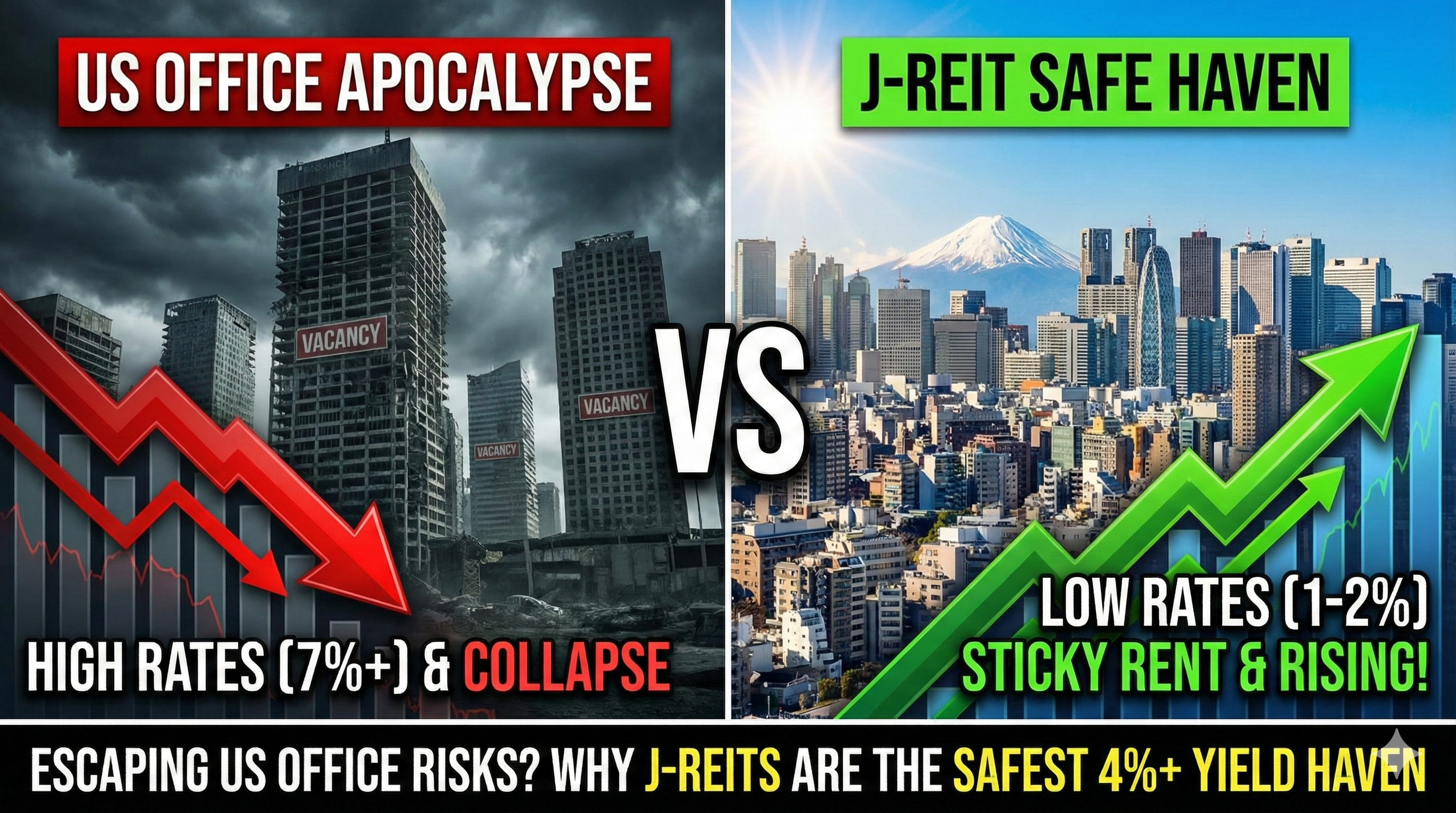
- ✅ The Anti-US Market: While US offices face soaring vacancies, Tokyo’s office market is thriving with low vacancy rates (~5%) due to a strong “return-to-office” culture. Rents in prime locations are rising.
- ✅ The “Sticky Rent” Advantage: Unlike the US, Japanese rents are notoriously “sticky”—once they go up, they rarely go down due to unique legal and cultural norms. This ensures stable long-term cash flow.
- ✅ Massive Interest Rate Gap: US REITs are crushed by 7%+ refinancing costs. J-REITs still borrow at ultra-low long-term fixed rates (often 1%-2%), providing a massive profitability cushion.
For US income investors, the commercial real estate sector has become a horror show. The “office apocalypse” driven by remote work, combined with the shock of soaring interest rates, has crushed valuations and threatened dividends. Many US REITs are now “uninvestable.”
But what if I told you there is a major developed real estate market that is the exact opposite of the US? A market where offices are full, rents in prime locations are rising, and borrowing costs remain rock-bottom?
Welcome to J-REITs (Japanese Real Estate Investment Trusts). Here is why Japan is the ultimate safe haven—and growth opportunity—for global real estate investors right now.
The biggest difference between New York and Tokyo is the culture. While US cities struggle with ghost towers, Japanese workers have largely returned to the office. Tokyo’s average office vacancy rate is hovering around a healthy 5%.
It’s not just stable; it’s growing. In prime locations (like Tokyo’s Marunouchi or Shibuya districts), demand for high-quality A-class buildings is intense. Companies are competing for space, driving property prices and rents significantly higher.
Unlike the US where landlords are slashing rents to attract tenants, Japanese landlords in prime areas hold pricing power.
Here is a unique characteristic of the Japanese market that income investors love: Rents are incredibly “sticky.”
In Japan, due to strong tenant protection laws and long-term business practices, it is very difficult for landlords to raise existing rents rapidly, BUT it is also equally difficult for rents to go down once they are set.
Even during economic downturns, tenants rarely demand rent cuts, and landlords are not forced to offer them easily. This makes cash flows from J-REITs remarkably stable compared to the volatile US market.
In the current inflationary environment, new leases are signing at higher rates, slowly pulling the entire average up, while the “sticky” nature protects the downside. It’s a “one-way ratchet” for stable income.
Real estate is a leverage business. The cost of debt defines profitability. This is where the gap between the US and Japan is widest.
This massive spread between rental income (cap rate) and borrowing costs ensures healthy, sustainable dividends for J-REIT investors.
Why catch a falling knife in the US office market? Japan offers a unique combination of a stable “return-to-office” culture, rising rents in prime locations, “sticky” downside protection, and the world’s lowest borrowing costs.
With average yields across the J-REIT sector offering stable 4%+ dividends, and the historic Weak Yen offering a currency discount on top, J-REITs are the ultimate shelter for your real estate capital.
The content on this website is for informational and educational purposes only and does not constitute financial, legal, or investment advice. The views expressed are the personal opinions of the author (DividendDan), based on experience as a strategy consultant and individual investor living in Japan.
Market data and company information are subject to change. Please conduct your own due diligence or consult a certified financial advisor before making any investment decisions. The author may hold positions in the securities mentioned.