How to Select Japan’s Best Dividend Growth Stocks
s7たち
Best Japan Stocks
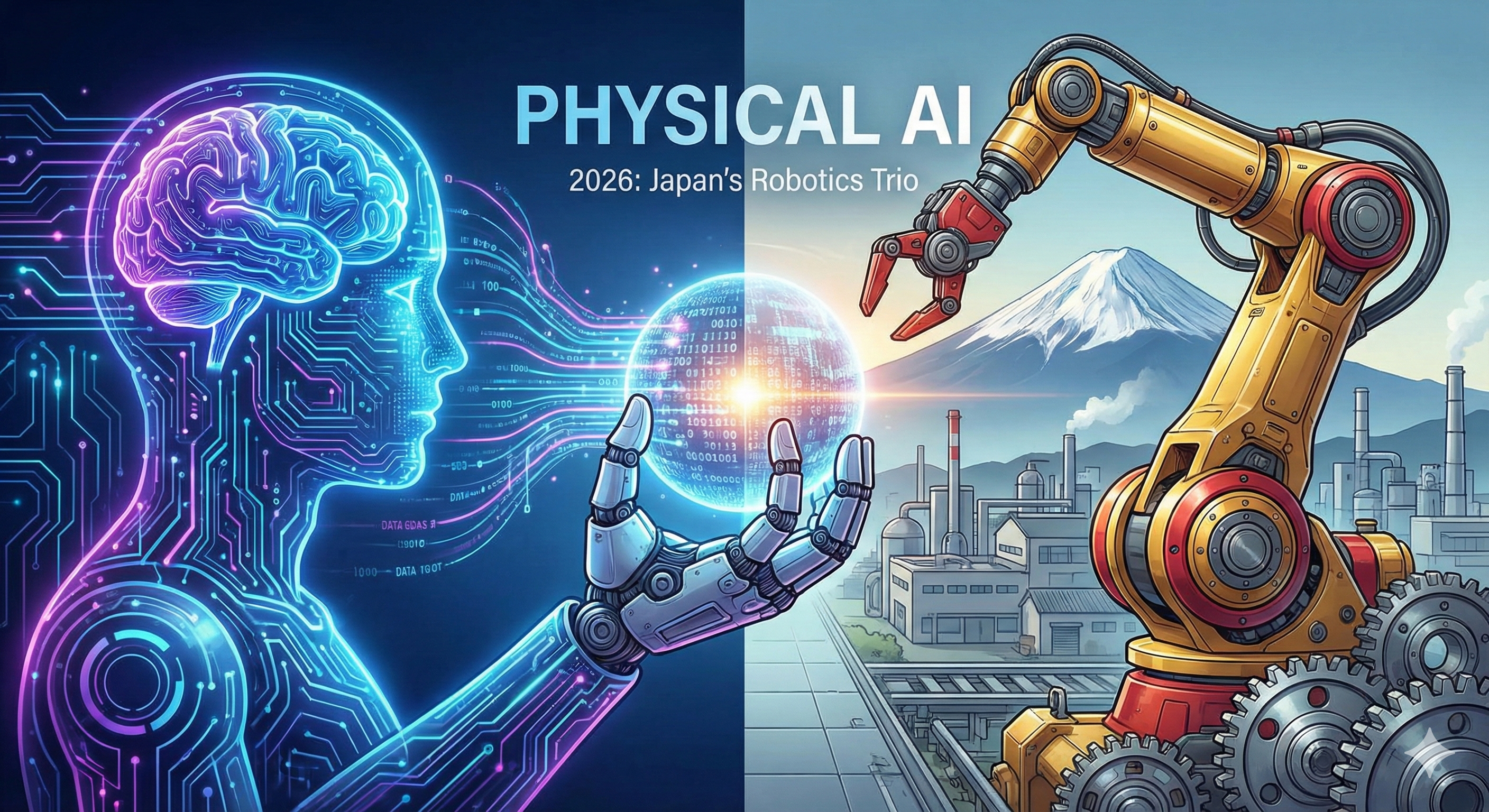
Category: Market Strategy / Physical AI / Japan Stocks Tickers: 6954 (FANUY), 6506 (YASKY), 6324 (HSYDF) Date: January 2026
Until 2025, the stock market was obsessed with NVIDIA’s GPUs and the linguistic wizardry of OpenAI. But as of January 2026, the narrative in Silicon Valley has shifted. The next frontier is “Physical AI.”
For decades, robotics was held back by “Moravec’s Paradox”—the idea that high-level reasoning (like chess) is computationally easy, but basic physical movement (like turning a doorknob) is impossibly hard.
In 2026, this paradox is dead. The killer was the “Scaling Law,” proven by OpenAI. They demonstrated a brute-force truth: If you feed a model enough data, intelligence emerges naturally.
Investors have realized: “What happens if we apply this law to robots?” The game has changed from “crafting perfect algorithms” to “a total war of volume—flooding the world with hardware to suck up physical data.”
To make AI smart, you need to feed it. Text data lives on the internet (dominated by US Big Tech). But physical data—gravity, friction, inertia, and torque—lives in the real world. specifically, on factory floors.
This is where Japan holds an unassailable “Moat.” The companies that operate the world’s production lines and possess the “golden physical data” of motor temperatures and load currents are not GAFAM. They are Japanese manufacturers.
If “Data = Intelligence,” then the company with the largest installed base of active robots wins. That company is Fanuc.
Fanuc’s power lies in its 1 million+ installed base. These yellow robots are not just laborers; they are “Edge Sensors” collecting physical data 24/7/365 across the globe.
This is why NVIDIA CEO Jensen Huang chose Fanuc as a strategic partner. To train NVIDIA’s “AI Brain,” they desperately needed Fanuc’s massive library of “Body Data.” Investing in Fanuc is not buying a machinery stock; it is buying the world’s largest physical data platform.
Factory data is structured and clean. But for AI to truly generalize, it needs messy, unpredictable data from the “Chaos” of the real world. This is Yaskawa’s territory.
Through its alliance with SoftBank, Yaskawa is taking robots “out of the cage.” Offices, hospital corridors, logistics hubs. Yaskawa’s autonomous “MOTOMAN NEXT” robots operate in these unstructured environments, harvesting unique “Real-World Data” that competitors lack.
“Will Tesla’s Optimus win? Or will a Chinese rival take the crown?” Don’t worry about picking the winner. There is one company that wins no matter who leads the race: Harmonic Drive Systems.
To apply Scaling Laws to robotics, you need millions of hardware units. When humanoid robots enter mass production, the critical bottleneck will be the “Reduction Gears” (Joints). A single humanoid requires dozens of these ultra-high-precision gears to move smoothly.
Holding roughly 50% of the global market, Harmonic is the ultimate “Pick and Shovel” play. If robot production scales 10x, Harmonic’s revenue scales with it.
“AI Stocks” usually imply bubble valuations. Japan is the exception.
OpenAI taught us a simple investment truth: Invest where the data gathers.
In the era of Physical AI, the most valuable data doesn’t gather in a server farm. It gathers in Japanese factories and inside the precision hardware shipped from them.
In 2026, owning this “Japanese Robotics Trio” is the most rational strategy to capture the Second Wave of the AI Revolution.
This was the overview. Next, we will dive deep into the specific technologies and strategies of each giant.
The content on this website is for informational and educational purposes only and does not constitute financial, legal, or investment advice. The views expressed are the personal opinions of the author (DividendDan), based on experience as a strategy consultant and individual investor living in Japan.
Market data and company information are subject to change. Please conduct your own due diligence or consult a certified financial advisor before making any investment decisions. The author may hold positions in the securities mentioned.