Japan’s “Supermajority” Moment: Why the Election & The Snow Signal a Golden Age for Stocks
Executive Summary: The Snow, The Silence, and The Buy Signal
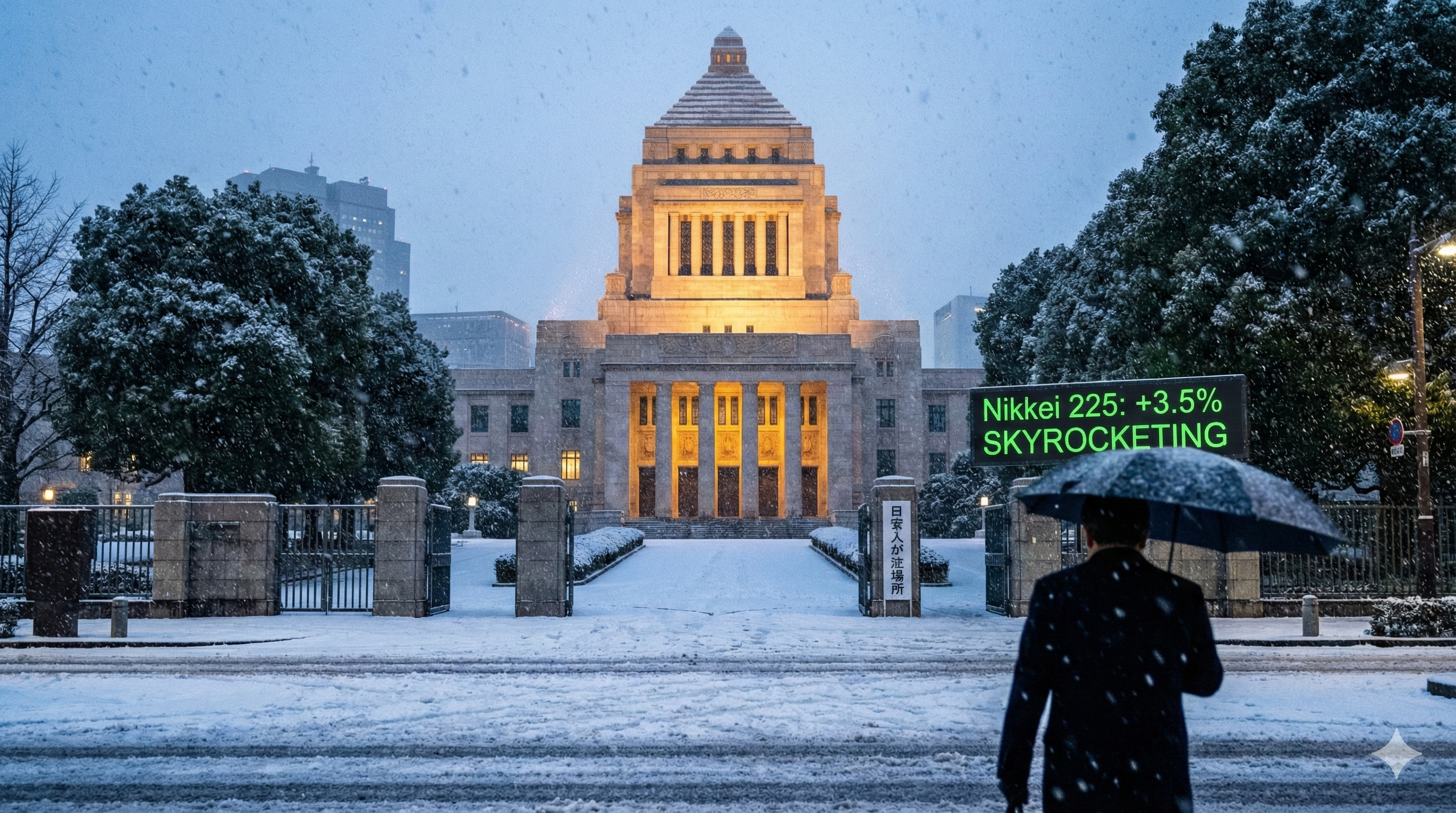
It was February 8th, 2026. A Sunday that Tokyo will not forget. I woke up to a city buried in white. The trains were delayed, the highways were closed, and the temperature was freezing. In a normal country, or perhaps in the “Old Japan,” this would have been the perfect excuse for voter apathy.
But as I walked to my local polling station, slipping on the icy pavement, I saw something that defied the headlines of the mainstream media. There was a line. People were not staying home. They were standing in the snow, silent but determined.
The global media, from the comfort of their heated offices, reported the landslide victory of the Liberal Democratic Party (LDP)—securing a two-thirds “Supermajority” in the Lower House—as a result of “organizational votes” or “lack of alternatives.” They are wrong.
From the ground, I can tell you the truth: This was not a vote for the status quo. It was a rejection of “weak politics.” It was a rejection of foreign interference. It was a mandate from a public that has finally awoken to the reality that Japan must become strong again.
The market responded immediately. The Nikkei is skyrocketing. Why? Because for the first time in decades, the “Political Discount” on Japanese stocks has evaporated. The uncertainty is gone. This is not a short-term rally. It is the beginning of a structural bull market driven by a nation that has decided to reclaim its sovereignty and its economy.
1. The Death of “Old Media” & The Birth of Public Will
To understand why this rally is sustainable, you have to understand the massive shift in Japan’s information landscape.
For months leading up to the election, the “Old Media” (TV networks and legacy newspapers) ran a fierce campaign against the ruling party. They focused on scandals, pushed for austerity, and championed opposition parties that advocated for “redistribution” over “growth.” In the past, this narrative would have worked. The elderly would have voted as told, and the youth would have stayed home.
But this time, the script flipped. The younger generation—the working class, the investors, the people building Japan’s future—turned to “New Media” (X, YouTube, independent journalism). They debated policy. They realized that Japan’s 30 years of stagnation were caused by indecisive politics and external pressure that kept Japan weak.
The result? The Old Media suffered a crushing defeat. The public chose “Growth” over “Redistribution.” They chose “Defense” over “Diplomatic Submission.”
This is the most bullish signal imaginable for a stock market. It means the populist pressure that usually leads to bad economic policies (like tax hikes on the rich or corporate restrictions) has been rejected. The path is now clear for pro-business, pro-growth policies to accelerate without obstruction.
2. The “Supermajority” Economics: Why the Economy Will Roar
A “Supermajority” (2/3 of seats) is a magic number in Japanese politics. It allows the ruling coalition to override the Upper House if necessary and initiates the process for Constitutional Reform. But for investors, it means one simple thing: Speed.
The “Gridlock” is dead. Here is how this political stability translates into an economic boom for the entire country.
A. The Return of “Animal Spirits” (CapEx Boom)
For decades, Japanese corporations (Japan Inc.) have been famous for hoarding cash. Why? Because they were afraid. They feared that a change in government would lead to higher taxes or sudden regulatory changes. Uncertainty was the enemy of investment.
With a guaranteed stable government for the next four years, that fear is gone. CEOs can now look at their massive cash piles and finally pull the trigger on Capital Expenditures (CapEx). We are about to see a wave of investment in:
- Factory Automation: To counter labor shortages.
- Digital Transformation (DX): To modernize legacy systems.
- M&A: To consolidate fragmented industries. When companies spend, the economy moves. The “internal reserves” are finally turning into “growth engines.”
B. National Policy as the Growth Driver
The Supermajority ensures that “National Strategy” policies are executed, not just debated.
- Defense Expansion: The budget increase to 2% of GDP is now a “floor,” not a ceiling. This money flows directly into heavy industry, technology, and R&D.
- Energy Security (Nuclear Restart): This is the biggest game-changer. The public mandate has effectively silenced the anti-nuclear opposition. To power AI data centers and semiconductor fabs (like TSMC and Rapidus), Japan needs cheap, stable baseload power. Nuclear restarts are now a certainty. This lowers energy costs for all manufacturers and boosts competitiveness.
C. The End of Deflationary Mindset
Perhaps the most important shift is psychological. When a country chooses “Strength,” the currency reflects it. We are moving away from the “cheap Japan” reliant on weak yen, toward a “strong Japan” that attracts global capital. The Bank of Japan (BOJ) now has the political cover to normalize interest rates. A world with positive interest rates forces “zombie companies” to exit and allows healthy companies to thrive. It restores the metabolism of the economy.
3. The “Japan Revival” Portfolio: Where to Invest?
This is not a narrow rally. The “tide” is rising for the entire economy. However, some boats will rise faster than others. Here is how I am playing this historic moment.
The Spearhead: Mitsubishi Heavy Industries (7011)
- The Logic: If the election was a referendum on “National Security,” MHI is the winner. As the prime contractor for defense, space, and energy (gas turbines & nuclear), they are the backbone of the state.
- The Opportunity: With the Constitution likely to be amended to clarify the status of the Self-Defense Forces, the stigma around “defense stocks” in Japan will vanish. Institutional money will flow here as a standard “industrial” allocation.
The Bloodstream: Mitsubishi UFJ Financial Group (8306)
- The Logic: An economy that grows is an economy that borrows. As businesses restart CapEx and the BOJ normalizes rates, the net interest margins (NIM) for mega-banks will expand significantly.
- The Valuation: Japanese banks are still trading at valuations that assume “perpetual stagnation.” They are not priced for a “Golden Age.”
The Muscle: ORIX Corp (8591)
- The Logic: ORIX is the ultimate proxy for corporate activity. They lease the machines for new factories, they finance the airplanes for renewed travel, they invest in the renewable energy projects, and they own the real estate.
- The Yield: A shareholder-friendly giant that pays you to wait while the economy heats up.
Conclusion: The Snow Couldn’t Stop Us
If you are sitting in New York or London, looking at a chart of the Nikkei and thinking, “It’s too high, I missed the boat,” think again. You are looking at the price, but you are missing the value.
For 30 years, Japan traded at a discount because of its “political paralysis.” On February 8th, in the freezing snow, the Japanese people voted to end that paralysis. They rejected foreign interference and chose to take control of their own destiny.
The “Political Discount” is gone. We are entering the era of the “Growth Premium.” The rally hasn’t ended. It has just begun.
Don’t bet against a nation that just woke up.
Disclaimer: I am long 7011, 8306, and 8591. This article is for informational purposes only and does not constitute financial advice. Do your own due diligence.
