Educational research only, not investment advice. Market data changes frequently. See the full Disclaimer.
Data freshness: Market prices, yields, valuation multiples, and forecasts in this article are dated snapshots rather than live quotes. Page maintenance review: July 10, 2026. Verify current quotes and the latest official IR guidance before making a decision.
Disclosure: This article contains affiliate links to TradingView. We may earn a commission at no extra cost to you.
¥150 billion in buybacks. A 46% payout ratio. And a stock trading at 0.61x book. Bridgestone (5108) keeps returning cash while most investors scroll past it — and that gap between fundamentals and price tends not to last. — DividendDan
Investment Thesis | Data snapshot: May 2026; page maintenance review: July 10, 2026
Author’s View: Constructive | Fair Value Estimate (Author’s Model): Thesis-based re-rating toward 14–15x forward earnings
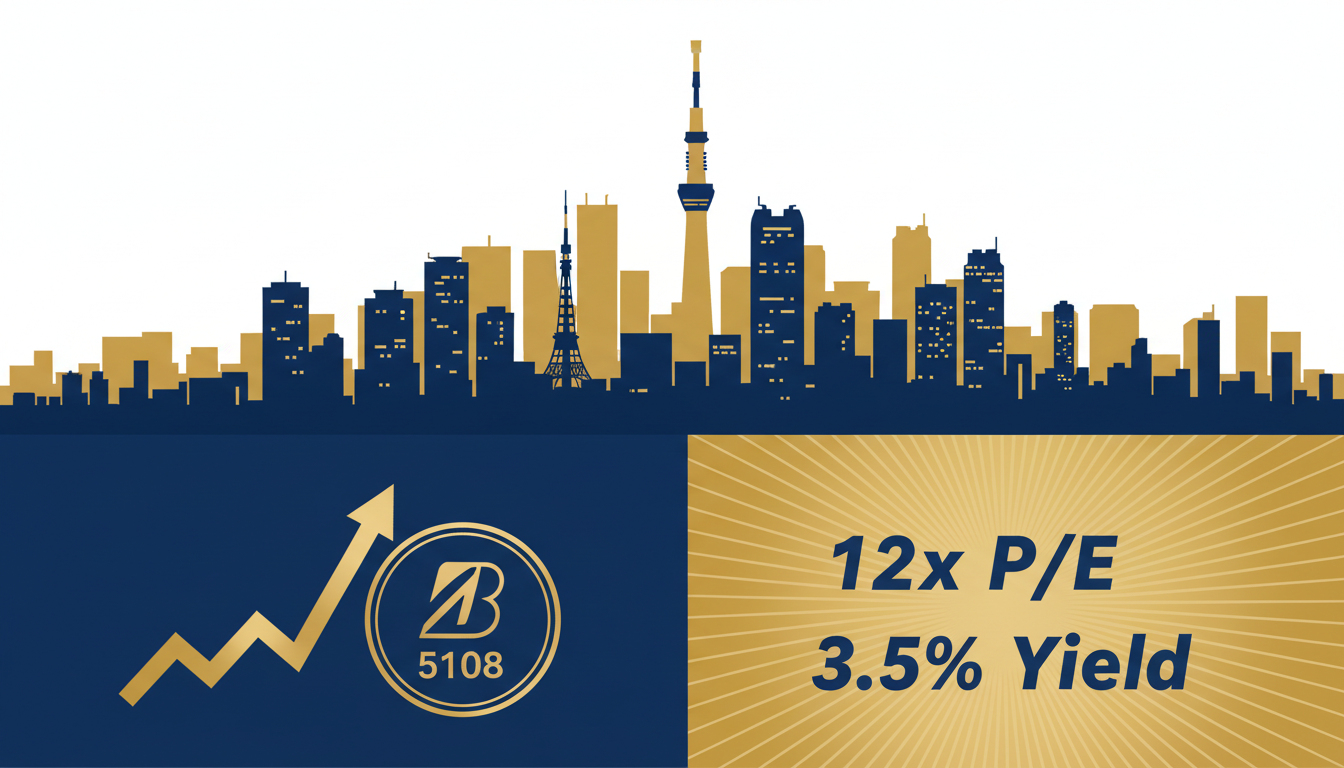
- World’s second-largest tire maker by revenue, trading at 12.6x P/E and 0.61x book — a meaningful discount to Michelin — while executing a ¥150 billion share buyback and sustaining a ~3.5% dividend yield.
- Q1 FY2026 standalone revenue +5.2% YoY, adjusted operating profit +9.7% YoY, profit attributable to owners +21.4% YoY — momentum is accelerating, not fading.
- Key risk: ¥55 billion estimated annual gross impact from U.S. tariffs plus rising raw-material costs from Q2 2026 onward could compress margins.
Educational content only — not investment advice. The author does not currently hold positions in stocks mentioned. See Disclaimer for FTC 16 CFR Part 255 compliant details.
Most US dividend investors hunting for defensive yield gravitate toward consumer staples or utilities. Bridgestone (TSE: 5108 / OTC: BRDCY) rarely appears on their radar — and that gap between perception and reality is precisely where the opportunity lives.
This is not a commodity rubber company. It is a high-margin, globally significant industrial franchise that is simultaneously buying back shares, growing its premium-tire mix, and trading well below book value.
| Metric | Value |
|---|---|
| Stock Price (JPY) | ¥3,327 (May 21, 2026) |
| Annual Dividend per Share | ¥115 (FY2026 forecast) |
| Dividend Yield | 3.46% |
| P/E Ratio (TTM) | 12.59x |
| P/B Ratio | 0.61x |
| Market Cap | ¥4.44 trillion |
| Payout Ratio (FY2026 est.) | 46.1% |
| TSE Listing Tier | Prime Market |
Note on yield math: ¥115 annual dividend ÷ ¥3,327 price = 3.46% yield, consistent with the company’s official IR dividend page.
What Bridgestone Actually Is
Bridgestone is the world’s second-largest tire manufacturer by revenue, behind Michelin. It operates across four business segments: Premium Tire (63% of H1 2024 revenue), Solutions Business (30%), Diversified Products, and Exploratory Business.
The Solutions Business — fleet management software, retread services, digital tire monitoring — is the segment most US investors miss entirely. It is higher-margin, recurring-revenue in nature, and growing faster than the core tire replacement cycle.
Bridgestone executed a 2-for-1 stock split on January 1, 2026, improving retail accessibility. The company employs 115,716 people globally as of December 31, 2025, per its Group IR filings.
Q1 FY2026 Earnings: Momentum Is Real
Q1 FY2026 (January–March 2026, standalone quarter) results beat consensus on both revenue and EPS:
- Revenue: ¥1,113.4 billion (+5.2% YoY)
- Adjusted Operating Profit: ¥122.2 billion (+9.7% YoY)
- Profit Attributable to Owners: ¥92.1 billion (+21.4% YoY)
- Basic EPS: ¥72.37 (beat consensus)
These are standalone Q1 figures, not cumulative. The 21.4% YoY jump in net profit is notable — it signals operating leverage is kicking in as premium-tire mix improves and fixed costs are spread over higher volumes.
Full earnings details are available via Investing.com’s Bridgestone earnings page and the company’s Matsui Securities financial summary (Japanese).
Capital Return: The ¥150 Billion Buyback Story
Bridgestone announced a share repurchase program on February 16, 2026, to buy back up to 60,000,000 shares (4.7% of capital) for up to ¥150 billion by August 31, 2026. All repurchased shares are to be cancelled — this is genuine capital reduction, not treasury stock accumulation.
Between February 16 and March 31, 2026, the company already repurchased 14,430,200 shares for ¥49.7 billion. That is roughly one-third of the program completed in six weeks.
Combined with the 46.1% projected payout ratio for FY2026, total shareholder return (dividends + buybacks) is tracking well above what the headline yield alone suggests. This is the kind of capital discipline that TSE governance reforms were designed to encourage — and Bridgestone is delivering.
Japan Edge: What Japanese Sources Add to the Bridgestone Thesis
The useful Japan-only angle on Bridgestone is not simply that it is a famous tire brand. Japanese filings and local investor pages show a company trying to turn a cyclical tire franchise into a more disciplined capital-return and ROIC story.
The English headline is “cheap tire stock.” The Japanese read is closer to “premium mix, restructuring, buybacks, and whether management can keep earning above its cost of capital.”
1. The TSE-style 決算短信 tells you exactly where the current earnings bridge stands. Bridgestone’s FY2026 Q1 filing, translated from the Japanese-language KESSAN TANSHIN format, shows revenue of ¥1,113.4 billion (+5.2% YoY), adjusted operating profit of ¥122.2 billion (+9.7%), and parent profit of ¥91.9 billion (+21.4%).
The same filing keeps full-year FY2026 guidance at ¥4.5 trillion revenue, ¥515.0 billion adjusted operating profit, and ¥340.0 billion parent profit (Bridgestone FY2026 Q1 results).
For a U.S. investor, the important point is not just the beat. Management did not raise guidance despite a strong Q1, so the watch item is whether tariffs and raw material costs are absorbing the upside.
2. Japanese shareholder-return disclosure makes the buyback more concrete than many screeners show. Bridgestone states a policy of pursuing continuous dividend increases through a stable consolidated payout ratio of 50%.
Its shareholder-return page lists a February 17, 2026 to August 31, 2026 buyback authorization of up to 60,000,000 shares and up to ¥150 billion (Dividend and shareholder return).
Because Bridgestone completed a 2-for-1 stock split effective January 1, 2026, older dividend-per-share and share-count comparisons can mislead if a data vendor has not normalized them. This is a practical reason to read the Japanese IR pages directly before relying on a yield screen.
3. The 2024-2026 mid-term plan changes what to monitor. The official mid-term plan page frames Bridgestone’s goal as becoming a sustainable solutions company toward 2050, built around “new & true glocal portfolio management” and business shaping through 2024-2026 (Mid-Long Term Business Strategy).
Translate that into investor language: this is not only a volume story. The key watch items are premium tire mix, solutions revenue quality, restructuring progress, and ROIC discipline.
If those improve while buybacks continue, the low multiple is more defensible as an opportunity. If they stall, the stock can stay cheap for good reasons.
4. Local sentiment is mixed, which is useful rather than negative. Japanese retail pages such as みんかぶ and domestic brokerage pages highlight consensus targets, dividend yield, and investor mood around 5108 in a way English ADR pages often miss (みんかぶ 5108).
Pair that with employee-review signals from En Kaisha: product franchise and social contribution scores look stronger than management-execution scores.
The takeaway is specific: Bridgestone is not a “set and forget” dividend stock. It deserves a watchlist slot only if the next quarters confirm that premium mix and capital discipline are offsetting tariff, rubber, and restructuring pressure.
Investor takeaway: for U.S. investors, Bridgestone’s Japan Edge is the ability to triangulate three local signals: TSE-format earnings conservatism, Japanese shareholder-return disclosures, and domestic sentiment around management execution.
The stock becomes more interesting if FY2026 guidance is revised up or the ¥150 billion buyback advances without weakening the balance sheet. It becomes less interesting if Q2/Q3 show that raw material inflation and U.S. tariff costs are consuming the Q1 margin improvement.
EV Tailwind: Heavier Cars, Faster Tire Wear
Electric vehicles are 20–30% heavier than equivalent internal combustion engine vehicles due to battery pack weight. Heavier vehicles generate more friction and wear through tires faster — a structural tailwind for replacement tire volume that is independent of new-car sales cycles.
Bridgestone’s strategic push into high-rim-diameter premium tires (the segment EVs disproportionately use) positions it to capture higher ASP per unit as the EV mix in the global fleet rises. The Japanese government’s active promotion of BEVs and PHEVs through clean-energy subsidies accelerates this domestic transition.
This is not a near-term catalyst — it plays out over 3–7 years. But for a 50-65 year old dividend investor building a Japan allocation, that time horizon is entirely appropriate.
Shareholder Perks (株主優待)
Bridgestone does not offer a 株主優待 (kabunushi yutai) shareholder perk program. This is notable because many large Japanese corporations do. The absence means Bridgestone’s entire shareholder return is delivered via dividends and buybacks — which is actually more accessible and tax-efficient for overseas investors.
Risks and Counter-View
1. U.S. Tariff Headwind: Bridgestone estimates an annual gross impact of ¥55 billion from U.S. tariffs. With roughly 20% of revenue exposed to North America, any escalation in trade policy is a direct earnings risk. The company has not yet fully disclosed mitigation strategies.
2. Raw Material Cost Pressure: Management has flagged higher raw material costs from Q2 2026 onward. Natural rubber and synthetic rubber (derived from petrochemicals) are both subject to commodity cycles. A sustained cost spike could compress the operating margin improvement seen in Q1.
3. Yen Appreciation Risk: Bridgestone reports in yen. For US investors holding BRDCY (OTC ADR) or TSE shares, a strengthening yen actually boosts USD-equivalent returns. But a weakening yen — the more common recent scenario — compresses them. This is a two-way FX risk that deserves a position-sizing discipline.
4. Workforce Reduction Trend: Consolidated headcount fell 4.73% (5,748 employees) from 2024 to 2025, continuing a decline since 2019. This could reflect efficiency gains — or it could signal structural demand softness in certain markets. The Japan domestic car market was down 0.7% year-to-date in 2026.
5. Management Quality Signal: As noted in the En Kaisha data above, internal management ratings are below average. For a company executing a complex global strategy across four business segments, leadership quality is a non-trivial execution risk.
Bottom Line — Author’s View: Constructive
Bridgestone at 12.6x P/E, 0.61x book, and 3.46% yield is not a screaming bargain — but it is a disciplined value case. The ¥150 billion buyback (4.7% of capital, all to be cancelled) is the kind of concrete capital-return commitment that underpins dividend sustainability even if earnings growth disappoints.
The Q1 FY2026 beat (+21.4% net profit YoY) suggests the operating leverage story is intact. The En Kaisha management score (2.6–3.1 / 5.0) is a genuine caution — but the buyback program is a mechanical return mechanism that doesn’t depend on management brilliance to deliver value.
For a US dividend investor seeking Japan exposure at a reasonable price, with a 46.1% payout ratio and a clear capital-return framework, Bridgestone belongs on the watchlist. The re-rating thesis toward 14–15x earnings is not guaranteed — but the downside is cushioned by the buyback floor and the sub-book valuation.
Frequently Asked Questions
How does Japanese dividend withholding work for US investors in an IRA?
Japan withholds tax on dividends paid to U.S. (non-resident) investors at a statutory rate of 15.315% (15% base rate + 0.315% reconstruction surtax).
U.S. individual investors holding portfolio positions may qualify for a reduced 10% treaty rate under the U.S.–Japan tax treaty (Article 10), but the lower rate applies only if your broker has collected the required treaty documentation (Form W-8BEN or equivalent); in practice, many retail investors receive the full 15.315% withheld at source.
The withheld amount is generally eligible for the foreign tax credit (IRS Form 1116) in taxable brokerage accounts; it is not recoverable in tax-advantaged accounts such as IRAs or 401(k)s.
What is the risk of buying Bridgestone via OTC (BRDCY) versus the TSE directly?
BRDCY trades over-the-counter in the US as an ADR equivalent. Liquidity is lower than the TSE-listed 5108, and bid-ask spreads can be wider. For larger positions or more precise execution, buying 5108 directly on the TSE via IBKR or Saxo Bank is preferable. Both routes carry the same underlying FX and business risk.
Does Bridgestone offer a shareholder perk (株主優待)?
No. Bridgestone does not operate a 株主優待 program. All shareholder returns are delivered via cash dividends and share buybacks — which is more accessible and more tax-efficient for US-based overseas investors than in-kind perks redeemable only in Japan.
How to Buy 5108 from the U.S.
Bridgestone (5108) trades on the Tokyo Stock Exchange, with BRDCY available as a US OTC alternative for those preferring dollar-denominated exposure. For direct TSE access, U.S. investors can use brokers that support Tokyo Stock Exchange trading. For step-by-step brokerage setup, ADR vs. direct TSE shares, and U.S. tax handling, see our complete guide: How to Buy Japanese Stocks from the U.S..
Primary Sources
Japanese-language IR and data sources: Bridgestone Group IR (日本語) | Dividend and shareholder return | みんかぶ 5108 | エン会社の評判 (En Kaisha 従業員評価)
English-language sources: Investing.com — Bridgestone Earnings | Companies Market Cap | JPX Market Data
This article is for informational and educational purposes only and does not constitute investment advice. Opinions are my own, not investment advice. The author does not currently hold positions in securities mentioned. Past performance is not indicative of future results. Data snapshot: May 2026; page maintenance review: July 10, 2026. See our full Disclaimer for FTC 16 CFR Part 255 compliant disclosure details.