Educational research only, not investment advice. Market data changes frequently. See the full Disclaimer.
Data freshness: Market prices, yields, valuation multiples, and forecasts in this article are dated snapshots rather than live quotes. Page maintenance review: July 10, 2026. Verify current quotes and the latest official IR guidance before making a decision.

Disclosure: This article contains affiliate links to TradingView. We may earn a commission at no extra cost to you.
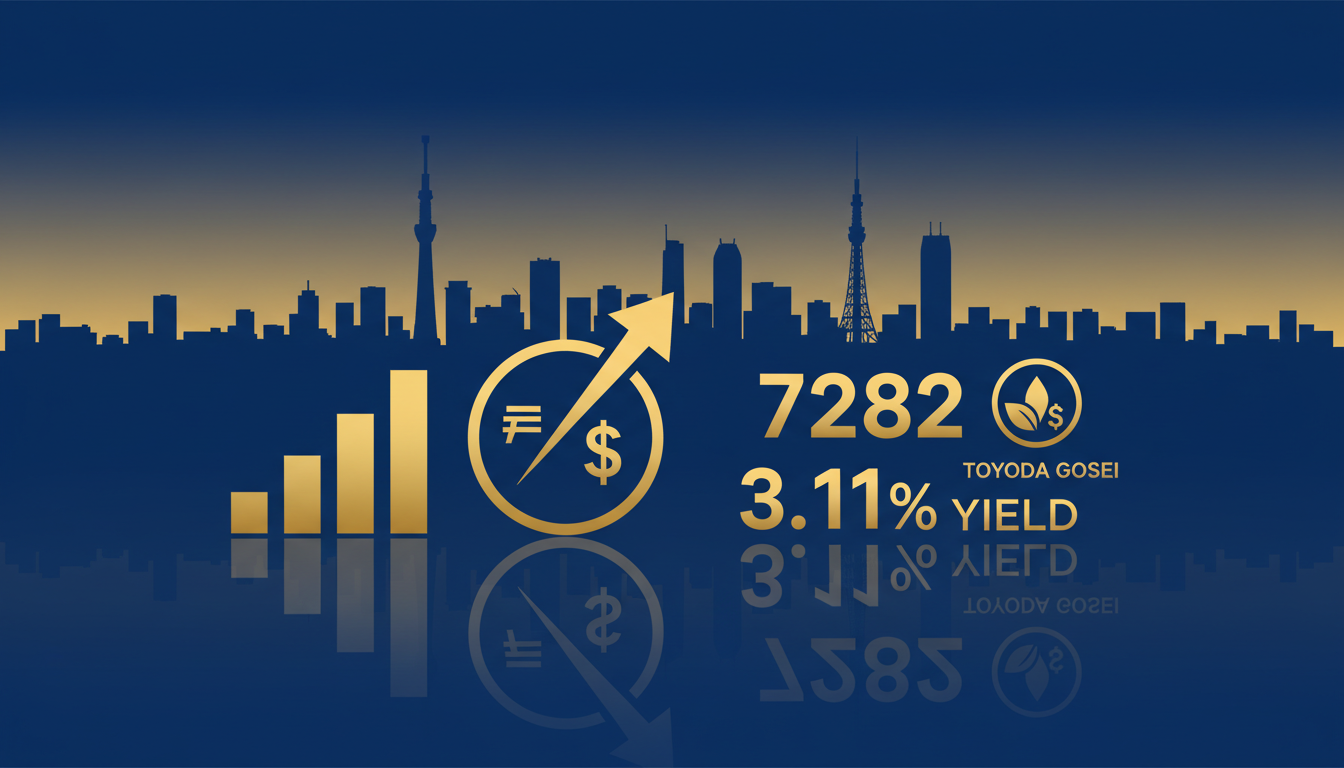
+31% dividend hike. Five-for-one stock split. Both announced April 28, 2026. Toyoda Gosei (7282) trades at 0.94x book and 9.4x earnings — sub-1x PBR, a 28% payout ratio, and ¥138/share annual dividend that most English screens still haven’t updated. Here is what the Japanese-language earnings report (決算短信) reveals about the payout trajectory.
Investment Thesis | Data snapshot: May 2026; page maintenance review: July 10, 2026
Author’s View: Constructive | Fair Value Estimate (Author’s Model): ¥5,030 (Minkabu (みんかぶ) analyst consensus, implying ~9% upside from ¥4,634)
- Toyoda Gosei raised its FY2026 total annual dividend 31% to ¥138/share, backed by a 70.7% net profit surge and an explicit DOE ≥2.5% floor policy — signalling policy-anchored income, not a one-off payout.
- Operating profit +32.9% YoY on ¥1.15 trillion revenue; payout ratio ~28%; PER 9.4x; PBR 0.94x — a TSE-reform value play with active share buyback (¥50 billion, up to 10 million shares).
- Top risk: FY2027 guidance projects lower net profit amid rising butadiene costs and EV-transition headwinds; dividend growth could stall if margins compress beyond management’s projections.
Toyoda Gosei (TSE: 7282) rarely appears on US investors’ radar. It sits quietly in the Toyota keiretsu, producing rubber seals, airbags, and optoelectronic components — unglamorous work that generates steady cash flow.
That changed on April 28, 2026, when the company announced a dividend hike that is difficult to dismiss as routine. Paired with a structural policy commitment and a forthcoming stock split, the announcement reframes Toyoda Gosei as an active participant in Japan’s governance-driven shareholder return story.
Before proceeding: this article is for informational purposes only and does not constitute personalised investment advice. The author does not currently hold positions in securities mentioned. Please read the full Disclaimer before making any investment decision.
| Metric | Value |
|---|---|
| Stock Price (JPY) | ¥4,634 (May 21, 2026) |
| Dividend Yield (TTM) | 2.98% |
| P/E Ratio (TTM) | 9.4x |
| P/B Ratio | 0.94x |
| Market Cap | ¥545 billion |
| Payout Ratio (approx.) | ~28% |
| 52-Week Range | ¥2,596 – ¥5,230 |
| FY2026 Annual Dividend | ¥138/share (+31% YoY) |
| ADR Ticker (OTC) | TGOSY |
What the April 28 Earnings Release Actually Said
Toyoda Gosei’s Japanese-language IR page (株主・投資家情報) contains language that most English-language summaries skip entirely: an explicit DOE (Dividend on Equity) floor of ≥2.5%.
That policy anchor matters. It means the board is not simply reacting to one strong year — it is committing to a minimum return-on-equity-based payout regardless of near-term earnings volatility.
The headline numbers behind the hike are equally compelling. For the fiscal year ended March 31, 2026, Toyoda Gosei reported revenue of ¥1,146,772 million (up 8.2% YoY) and operating profit of ¥79,551 million (up 32.9% YoY). Net profit surged approximately 70.7%.
The payout ratio sits at approximately 28% of earnings — leaving substantial headroom for further increases even if FY2027 profits soften modestly.
The Five-for-One Split: Signal or Noise?
A 5-for-1 stock split does not create value on its own. Your 100 shares become 500 shares; the per-share price drops proportionally; your total position value is unchanged at the moment of the split.
What the split does signal is management confidence. A lower per-share price improves retail accessibility and liquidity on the Tokyo Stock Exchange — consistent with TSE’s broader push to widen domestic retail participation.
For US investors holding via IBKR or Saxo, the split is a mechanical adjustment. Focus on the underlying business fundamentals and the sustainability of the dividend policy, not the per-share arithmetic.
TSE Governance Reform: Why PBR Below 1.0 Matters Here
Toyoda Gosei’s PBR of 0.94x places it below the 1.0 threshold that the Tokyo Stock Exchange has explicitly targeted through its ongoing corporate governance reform programme.
Companies trading below book value face growing pressure from TSE to demonstrate credible capital efficiency plans. Toyoda Gosei has responded directly.
In November 2025, the company announced a share repurchase programme of up to 10 million shares (7.86% of issued capital) for ¥50 billion. This buyback was partly designed to offset market impact from secondary sales by major shareholders including Toyota Motor and Sumitomo Mitsui Financial Group — a cross-shareholding unwind that is itself a governance reform story.
The combination of buyback + DOE floor + dividend hike is a coherent governance-response package. It is not accidental. The Financial Services Agency’s April 2026 consultation on Corporate Governance Code revisions only reinforces the direction of travel.
Japan Edge: What Domestic Sources Reveal
This is where reading Japanese-language sources directly provides an edge that most English-language analysis misses.
Minkabu (みんかぶ) analyst consensus: As of May 2026, domestic analysts on Minkabu (みんかぶ) show a “Buy” consensus with an average fair-value estimate of ¥5,030 — implying approximately 9.5% upside from the May 21 price of ¥4,634. This institutional optimism supports the thesis that the governance re-rating story has further to run.
However, retail investor sentiment on the same platform (as of mid-May 2026) leans toward “Sell,” with a crowd-predicted price of ¥3,621. This divergence between institutional and retail views is a meaningful signal: domestic retail investors are more skeptical of near-term momentum than the analyst community, which warrants position-sizing discipline.
OpenWork employee scores: OpenWork reviews for Toyoda Gosei show overall scores in the 2.1–2.3/5.0 range from recent years, with the company ranking 2,008th in compensation satisfaction — well below its 71st-place ranking in compliance awareness.
For dividend investors, low compensation satisfaction is a soft risk flag. Companies that underinvest in talent retention may face higher turnover in engineering roles critical to the EV-transition pivot. This does not break the thesis, but it is a management quality signal worth monitoring alongside the hard financial numbers.
Business Model: What Toyoda Gosei Actually Makes
Toyoda Gosei is a top-four global airbag supplier with an estimated 18% market share in safety systems. Beyond airbags, the product mix includes weatherstrips, interior and exterior rubber components, functional parts, and optoelectronic products (LEDs).
The company operates across Japan, the Americas, Europe and Africa, China, Asia, and India. Approximately 39,192 employees serve a customer base anchored by Toyota Motor — concentration that is both a strength (stable volumes) and a risk (single-customer dependency).
The forward-looking investments are in lightweight resins, hydrogen tanks, and next-generation steering systems — areas that position Toyoda Gosei for relevance in a BEV and autonomous-driving world, even as traditional rubber component volumes face long-term pressure.
The company has also announced horizontal recycling technology for plastic automotive parts — a sustainability initiative that aligns with tightening European and Japanese regulatory requirements on automotive supply chains.
FY2027 Guidance: Where the Caution Lives
The Kaisha Shikiho (四季報) domestic earnings forecast for FY2027 (ending March 31, 2027) projects revenue of ¥1,200,000 million (up 4.6% YoY) and operating profit of ¥80,000 million (up just 0.6% YoY).
More importantly, net profit attributable to owners is forecast to fall 8.1% YoY. This confirms that FY2026 benefited from non-recurring tailwinds that will not repeat in full.
For dividend investors, the key question is whether the DOE floor policy holds even if net profit declines. The 28% payout ratio provides a meaningful buffer — but a sustained multi-year profit decline could eventually force the board to revisit the commitment.
Risks and Counter-View
A constructive view on Toyoda Gosei requires acknowledging three substantive counterarguments:
- EV transition headwinds: Traditional rubber components — weatherstrips, seals, conventional airbag housings — face structural volume pressure as EV architectures simplify vehicle interiors and reduce part counts. Revenue from legacy segments could decline faster than new-technology revenues ramp.
- Rising input costs: Butadiene, a key feedstock for synthetic rubber, has seen price volatility. Management has flagged this as a margin headwind in FY2027 guidance. If butadiene costs remain elevated, operating margin improvement stalls.
- Customer concentration and cross-shareholding unwind: Toyota Motor and Sumitomo Mitsui Financial Group have been selling down cross-shareholdings. While the buyback partially absorbs this supply, sustained secondary selling creates a structural overhang on the share price.
The retail investor skepticism visible on Minkabu (みんかぶ) (crowd target ¥3,621 vs. analyst consensus ¥5,030) is a useful reality check. Domestic retail investors often have ground-level awareness of supplier relationships and regional manufacturing conditions that institutional models miss.
Frequently Asked Questions
How are Japanese dividends taxed for US investors?
Japan withholds tax on dividends paid to U.S. (non-resident) investors at a statutory rate of 15.315% (15% base rate + 0.315% reconstruction surtax).
U.S. individual investors holding portfolio positions may qualify for a reduced 10% treaty rate under the U.S.–Japan tax treaty (Article 10), but the lower rate applies only if your broker has collected the required treaty documentation (Form W-8BEN or equivalent); in practice, many retail investors receive the full 15.315% withheld at source.
The withheld amount is generally eligible for the foreign tax credit (IRS Form 1116) in taxable brokerage accounts; it is not recoverable in tax-advantaged accounts such as IRAs or 401(k)s.
Can I hold Toyoda Gosei in an IRA?
Yes — IBKR and some other brokers allow Japanese stocks in IRA accounts. However, foreign tax credits (Form 1116) cannot be claimed inside a tax-deferred account. The 15.315% Japanese withholding is an unrecoverable cost in an IRA. Factor this into your net yield calculation.
What is the FX risk for US investors?
Toyoda Gosei pays dividends in yen. If USD/JPY rises (yen weakens), your dollar-equivalent dividend income falls. Over the past decade, yen weakness has been a meaningful drag on unhedged Japanese equity returns for US investors. Consider this a structural risk alongside the equity thesis.
How to Buy 7282 from the U.S.
Toyoda Gosei (7282) trades on the Tokyo Stock Exchange Prime Market, with a limited OTC listing (TGOSY) offering low liquidity for U.S. traders. For direct exposure, U.S. investors can access. For step-by-step brokerage setup, ADR vs. direct TSE shares, and U.S. tax handling, see our complete guide: How to Buy Japanese Stocks from the U.S..
Bottom Line — Author’s View on 7282 for 2026
Toyoda Gosei is not a high-octane growth story. It is a value-and-income play at 9.4x earnings and 0.94x book, with a policy-anchored dividend that just jumped 31% and a buyback absorbing cross-shareholding supply.
The Minkabu (みんかぶ) analyst consensus of ¥5,030 (approximately 9.5% above current levels) is consistent with a governance re-rating thesis. The DOE floor, the ¥50 billion buyback, and the TSE reform tailwind all point in the same direction.
The caution flags are real: FY2027 net profit is forecast down 8.1%, butadiene costs are a margin wildcard, and the OpenWork compensation scores (2,008th nationally) suggest talent retention challenges that could slow the EV-pivot execution.
For a US dividend investor seeking Japan exposure at a reasonable valuation — with a payout ratio of only 28% providing dividend safety cushion — Toyoda Gosei warrants a position on the watchlist and a small initial allocation sized to the FX risk tolerance. The yield at current prices (~2.98%) is modest but growing, backed by policy rather than hope.
Primary Sources: Toyoda Gosei IR (Japanese) | Minkabu (みんかぶ) 7282 | OpenWork (Japanese employee reviews) | JPX Corporate Governance Reform | Japan FSA | Investing.com Dividend History
Disclaimer: This article is for informational purposes only and does not constitute investment advice. Opinions are my own, not investment advice. I do not currently hold positions in securities mentioned. This disclosure is made in accordance with FTC 16 CFR Part 255. Please review the full Disclaimer before acting on any information in this article. Data snapshot: May 2026; page maintenance review: July 10, 2026.
Related research
Disclosure: Educational research only; not a recommendation to buy or sell securities. Verify current company filings, market prices, tax rules, and broker access independently. See the full Disclaimer.