
Educational research only, not investment advice. Market data changes frequently. See the full Disclaimer.
| Metric | Value |
|---|---|
| Price (JPY) | Y7,108 |
| Dividend Yield | 3.87% |
| P/E Ratio (TTM) | 21.2x |
| Market Cap | Y12.6t |
| 52-Week Range | Y4,652 – Y7,218 |
Data freshness: Market prices, yields, valuation multiples, and forecasts in this article are dated snapshots rather than live quotes. Page maintenance review: July 10, 2026. Verify current quotes and the latest official IR guidance before making a decision.
Disclosure: This article contains affiliate links to TradingView. We may earn a commission at no extra cost to you.
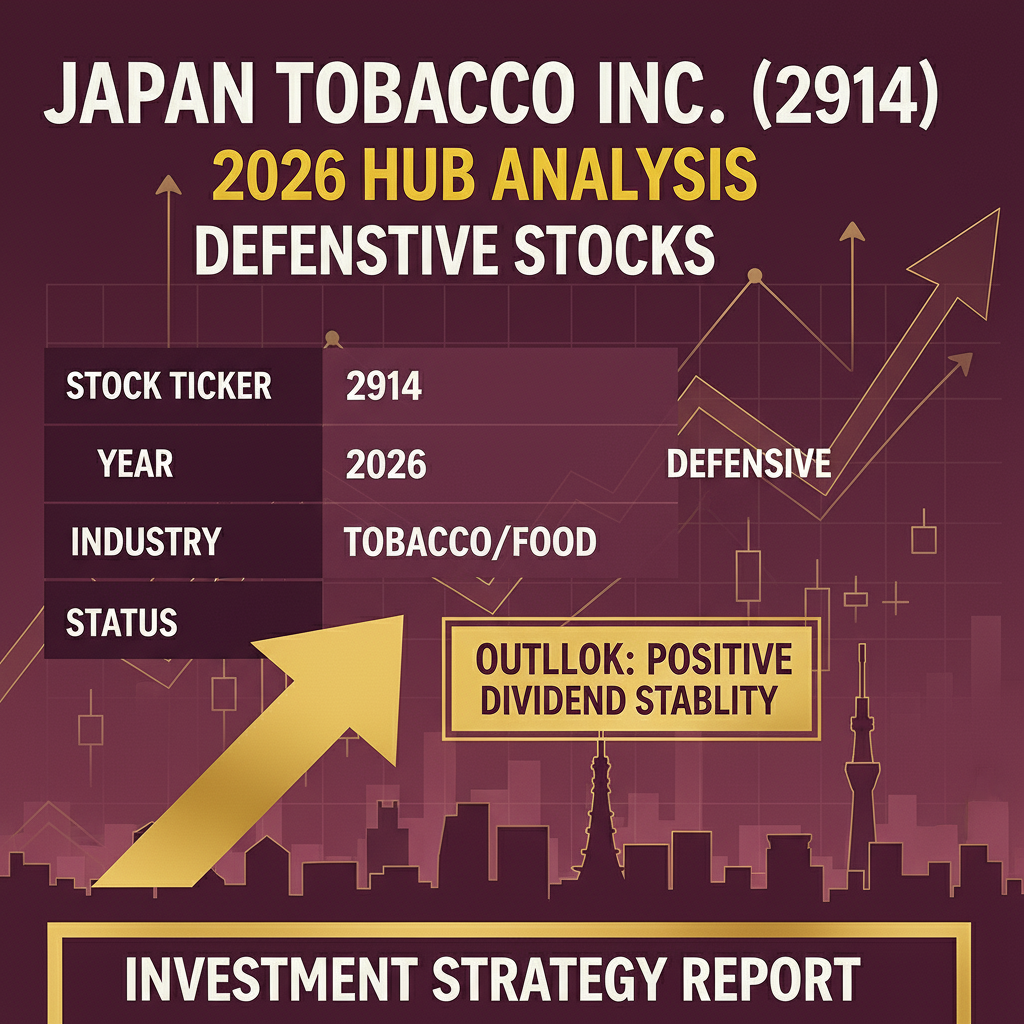
Constant-FX adjusted operating profit: +24.9% in FY2025. Forward yield: ~3.9%. Payout ratio: ~39%. English analyst notes consistently omit the constant-FX breakdown buried in JT’s earnings report (決算短信) supplemental slides — the very figure that reframes what most Western investors dismiss as a slow-moving yield trap.
This article surfaces what the Japanese-language IR says that English summaries miss.
Investment Thesis
Author’s View: Constructive | Fair Value Estimate (Author’s Model): ¥6,400 (thesis-based on 2026 guidance + RRP optionality)
- Record FY2025 results (revenue +13.4%, adj. operating profit +21.5%) plus 2026 guidance of +8.9% operating profit growth give JT a rare blend of defensive cash flow and visible earnings acceleration — before Ploom X’s 40-market rollout registers in consensus models.
- Forward yield ~3.9% / PER ~19x / adj. operating profit ¥902.2 billion FY2025; overseas revenue ¥2.84 trillion cushions domestic volume decline.
- Top risk: Japan’s three-phase tobacco-tax hike (April 2026, October 2026, January 2027) narrows the excise gap between combustibles and HTPs, threatening the pricing power that underpins dividend growth.
Data snapshot: May 2026; page maintenance review: July 10, 2026
Japan Tobacco (TSE: 2914) last traded at ¥6,134 as of May 22, 2026 — a price that embeds a forward yield of approximately 3.9%, a ~19x earnings multiple, and limited credit for Ploom X’s international optionality.
This pillar article maps the full investment case: the FY2025 earnings inflection, the RRP transition race, the three-phase tax reform that English-language coverage consistently misdescribes, and the dividend architecture that makes JT a high-conviction defensive anchor for income-focused US investors.
Full disclosures apply — see the Disclaimer for details on author positions and FTC 16 CFR Part 255 obligations.
| Metric | Value |
|---|---|
| Price (JPY) | Y6,057 |
| Dividend Yield | 3.97% |
| P/E Ratio (TTM) | 21.5x |
| Market Cap | Y10.8t |
| 52-Week Range | Y4,139 – Y6,474 |
FY2025 Earnings: The Number English Coverage Missed
Japan Tobacco’s FY2025 results were, by any measure, exceptional. Total revenue reached ¥3.47 trillion, with the Tobacco segment alone contributing ¥3.31 trillion.
Adjusted operating profit (AOP) at constant foreign exchange rose 24.9% to ¥927.5 billion. Reported operating profit climbed 21.5% to ¥902.2 billion. These are not incremental improvements — they represent a genuine earnings inflection.
The momentum carried into Q1 2026. Consolidated AOP at constant FX increased 20.5% year-over-year. Operating profit rose 24.7% and net profit jumped 27.3%. Quarterly revenue was ¥923.9 billion; operating income was ¥302.4 billion.
These figures are disclosed in detail in JT’s official Japanese-language IR materials, including the earnings report (決算短信) (kessan tanshin) filed on TDnet. English summaries routinely omit the constant-FX breakdown.
The 2026 full-year guidance calls for operating profit growth of approximately +8.9% — not a deceleration story, but a company sustaining double-digit-adjacent growth on a much larger base.
Business Segments: Where the Money Is Made
Japan Tobacco operates three reportable segments: Tobacco (domestic + international), Pharmaceutical, and Processed Food.
The Tobacco segment is the profit engine. Of ¥3.47 trillion in total FY2025 revenue, ¥3.31 trillion came from tobacco. International Tobacco alone contributed ¥2.84 trillion — meaning more than 80% of tobacco revenue is generated outside Japan.
This geographic diversification is structurally important. JT’s international footprint spans Russia, the Middle East, Southeast Asia, and Western Europe. It cushions the company against Japan’s domestic volume decline, which has run at roughly 8% annually over the past five years.
Pharmaceutical and Processed Food segments are smaller contributors. They add diversification but are not material to the dividend thesis at this stage.
Ploom X and the RRP Transition Race
The most significant strategic question for JT’s next decade is whether its Ploom X heated tobacco brand can carve out durable market share against Philip Morris International’s IQOS and BAT’s glo.
PMI’s IQOS remains the dominant heated tobacco product globally, with particular strength in Japan — the world’s most developed HTP market. BAT competes aggressively with glo and Vuse across multiple formats.
JT has responded by expanding Ploom X to 40 markets. This rollout is not yet reflected in consensus earnings models, which tend to extrapolate existing combustible volume trends. If Ploom X achieves even modest share gains in key markets, the upside to current estimates is meaningful.
For US investors, this is the optionality embedded in a stock priced primarily as a yield vehicle. The market is paying for the dividend; the RRP transition is effectively free.
You can track JT’s RRP volume disclosures and market share data in the supplemental slides attached to each earnings report (決算短信) filing on JT’s IR page.
The Three-Phase Tax Hike: What It Actually Means
On March 27, 2026, Japan announced an overhaul of its tobacco tax structure to help fund defense spending. The hike takes effect in three phases: April 1, 2026; October 2026; and January 2027 (reported elsewhere as April 2027 — the April date is the correct reading of the government announcement).
Critically, the increase applies to both conventional cigarettes and heated tobacco products. This narrows the excise gap that had previously made HTPs more tax-advantaged relative to combustibles.
English-language coverage has frequently described this as a “cigarette tax hike,” missing the HTP dimension entirely. The convergence of tax treatment between product categories is the more important signal for JT’s pricing strategy and margin trajectory.
The near-term impact is manageable. JT has historically passed through tax increases via price hikes, and its international revenue base provides a buffer. But the three-phase structure means margin pressure will be recurring through at least mid-2027, not a one-time event.
Separately, Japanese health officials are reviewing HTP regulations following a government panel’s finding (published May 21, 2026) that some devices may produce higher levels of certain carcinogenic substances than conventional cigarettes. A broader policy proposal on passive smoking measures is expected later in 2026. See Tobacco Reporter’s coverage for the regulatory detail.
Dividend Architecture: Yield, Payout, and Sustainability
Japan Tobacco’s dividend policy is straightforward: the company prioritizes shareholder returns through cash dividends. In February 2022, JT formally abolished its 株主優待 (kabunushi yutai) shareholder benefit program, concentrating all returns into dividends. The last benefits were distributed in 2023 for eligible shareholders.
Note for US investors: The 株主優待 (kabunushi yutai) program has been discontinued. Even when it existed, this benefit was typically only redeemable by Japanese-resident shareholders holding via a Japanese brokerage account. US shareholders holding overseas generally could not claim it. The dividend and capital appreciation thesis remains intact regardless.
The official notice of abolition is available on JT’s IR press release page (Japanese).
At the current indicated dividend of ¥121 per share semi-annually (¥242 annualized) and a TTM EPS of approximately ¥310, the payout ratio is roughly 39%. This is conservative by global tobacco-sector standards, leaving meaningful room for dividend growth even if earnings growth moderates.
The forward yield at ¥6,134 is approximately 3.9%. Investors who entered at lower prices — the stock traded near ¥4,400 earlier in the 52-week range — are sitting on yields-on-cost closer to 5.5%. This is the structural advantage of buying defensive dividend compounders during market weakness.
Below is an illustration of annual income potential at current prices, assuming ¥150/$ exchange rate and before Japanese withholding tax.
| Investment (USD) | Approx. Shares (100-lot) | Est. Annual Income (USD) | Est. Monthly Income (USD) |
|---|---|---|---|
| $10,000 | ~100 shares | ~$161 | ~$13 |
| $25,000 | ~270 shares | ~$435 | ~$36 |
| $50,000 | ~540 shares | ~$870 | ~$73 |
| $100,000 | ~1,080 shares | ~$1,740 | ~$145 |
Japan Edge: Local Intelligence US Investors Can’t Easily Access
This section is where the blog’s Japan-based research provides genuine edge over English-only analysis.
Minkabu (みんかぶ) retail sentiment: As of May 23, 2026, the Minkabu (みんかぶ) consensus page for 2914 shows an average analyst fair-value estimate of ¥6,443 — implying approximately 5% upside from the May 22 close of ¥6,134. However, individual Japanese retail investor forecasts skew toward “sell” (売り), diverging from the professional analyst “buy” (買い) consensus.
This divergence is meaningful: Japanese retail investors, who follow JT closely as a domestic dividend stalwart, appear more concerned about the tax hike cycle and Russian market affordability issues than institutional models currently reflect. It does not change the constructive view, but it flags that near-term sentiment headwinds may cap the re-rating pace.
OpenWork employee satisfaction: JT’s OpenWork profile shows an overall rating of approximately 3.3–3.5 out of 5.0.
The company ranks 5th nationally for compensation satisfaction (待遇面の満足度) — a strong signal that management is sharing the company’s cash generation with employees, which correlates with retention and operational stability. Sub-scores for compliance awareness (法令順守意識) and long-term talent development (人材の長期育成) are strong.
Scores for employee morale (社員の士気) and the growth environment for younger staff (20代成長環境) are below average. For dividend investors, the compensation strength is the relevant signal: a company that pays employees well from a position of financial strength is more likely to sustain dividend commitments than one cutting costs to maintain the payout.
Competitive context: PMI’s IQOS dominates Japan’s HTP market. BAT’s glo competes on price. JT’s Ploom X is the domestic challenger — and the home-market dynamics visible in Japanese retail data and employee reviews provide a more granular read on execution quality than quarterly earnings alone.
Valuation: Cheaper Than PMI, But Is the Discount Justified?
Japan Tobacco trades at approximately 19x TTM earnings and 3.0x book. Philip Morris International trades at a meaningfully higher multiple, despite JT’s comparable — and in FY2025, superior — earnings growth rate on a constant-FX basis.
The discount reflects several factors: lower English-language analyst coverage, JPY currency risk perception, the regulatory uncertainty around the 2026 tax hikes, and a general market preference for US-listed dividend stocks among US investors.
None of these factors are permanent. The coverage gap is narrowing as TSE reforms attract international attention. The yen, while volatile, provides natural diversification for a USD-heavy portfolio. And the tax hike cycle, while a genuine headwind, is a known and finite risk — not an open-ended regulatory threat.
The Minkabu (みんかぶ) analyst consensus fair-value estimate of ¥6,443 implies only modest upside from current levels. This author’s model, which applies a 20x multiple to 2026 estimated EPS and adds RRP optionality, arrives at a similar ¥6,400 fair-value estimate. The investment case at current prices is primarily income-driven, with capital appreciation as a secondary return component.
For US investors comparing JT to domestic tobacco alternatives, the FX dimension adds complexity but also genuine diversification. A position in JT effectively adds JPY exposure to a USD-denominated portfolio — a hedge against USD weakness that most dividend portfolios lack.
You can screen and chart JT’s valuation history alongside global tobacco peers on TradingView, which provides direct TSE data access for international investors.
Risks and Counter-View
A constructive view requires an honest accounting of what could go wrong.
1. Three-phase tax hike cycle (primary risk). The April 2026, October 2026, and January 2027 excise increases are not fully priced into consensus estimates. If volume declines accelerate faster than management’s price-hike offsets, operating profit growth in H2 2026 and 2027 could disappoint.
The dividend is covered at a 39% payout ratio, but dividend growth — not just maintenance — requires earnings growth.
2. Russian market affordability pressure. JT’s post-Q1 2026 stock decline was partly driven by investor concern over affordability issues in Russia, one of JT’s largest international markets. Ruble volatility and consumer purchasing power constraints could weigh on international volume in 2026.
3. HTP regulatory tightening in Japan. The government panel’s May 2026 findings on HTP carcinogen levels could accelerate regulatory action on heated tobacco products. If Japan tightens HTP marketing or usage rules, it would directly impact JT’s domestic RRP growth strategy and potentially compress the Ploom X growth narrative.
4. JPY appreciation risk. JT’s international revenue base means a strengthening yen reduces reported yen-denominated profits. A sustained USD/JPY move toward 130 would create meaningful earnings headwinds versus current guidance assumptions.
5. ESG and institutional exclusion. Tobacco remains on the exclusion list for a growing number of ESG-mandated institutional funds. This structural selling pressure limits the multiple expansion available to JT regardless of earnings performance. US investors holding JT in ESG-screened accounts should verify eligibility.
Bottom Line — Author’s View: Constructive on 2914
Japan Tobacco is not a growth stock. It is a cash-generation machine operating in a structurally declining industry — and doing so with unusual efficiency.
FY2025 constant-FX AOP growth of 24.9%, a ~39% payout ratio on ¥310 EPS, and ¥2.84 trillion in international revenue add up to a dividend that is well-covered, internationally diversified, and growing. The three-phase tax hike is a real headwind, but it is a known headwind — not a surprise.
At ¥6,134 and a ~3.9% forward yield, JT is not cheap on an absolute basis. The constructive view rests on relative value: cheaper than PMI on earnings, better covered than BAT on payout, and carrying Ploom X optionality that the market is not pricing.
For a US investor building a defensive income sleeve with genuine geographic diversification, JT earns a place in the portfolio at current levels — sized appropriately for the FX and regulatory risks outlined above.
The Minkabu (みんかぶ) retail caution and OpenWork morale scores are noted. They do not change the thesis, but they do suggest the re-rating will be gradual rather than sharp.
Frequently Asked Questions
What is Japan Tobacco’s current dividend yield?
At ¥6,134 (May 22, 2026) and an indicated annual dividend of approximately ¥242 per share, the forward yield is approximately 3.9%. Investors who purchased at lower prices earlier in the 52-week range (near ¥4,400) have yields-on-cost closer to 5.5%.
What are the US tax implications of receiving JT dividends?
Japan withholds tax on dividends paid to U.S. (non-resident) investors at a statutory rate of 15.315% (15% base rate + 0.315% reconstruction surtax).
U.S. individual investors holding portfolio positions may qualify for a reduced 10% treaty rate under the U.S.–Japan tax treaty (Article 10), but the lower rate applies only if your broker has collected the required treaty documentation (Form W-8BEN or equivalent); in practice, many retail investors receive the full 15.315% withheld at source.
The withheld amount is generally eligible for the foreign tax credit (IRS Form 1116) in taxable brokerage accounts; it is not recoverable in tax-advantaged accounts such as IRAs or 401(k)s.
Why does JT trade at a discount to Philip Morris International?
The discount reflects lower English-language analyst coverage, JPY currency risk perception, the 2026 tax hike cycle, and institutional preference for US-listed dividend stocks. JT’s FY2025 constant-FX earnings growth actually exceeded PMI’s on a comparable basis — the valuation gap is an information and access gap, not a fundamental one.
Can US investors buy JT in an IRA?
Yes — Interactive Brokers and Saxo Bank both allow direct TSE purchases in taxable and retirement accounts, subject to account eligibility. Note that the 15.315% Japanese withholding tax applies regardless of account type. There is no JT ADR currently trading on US exchanges, so direct TSE access via an international broker is required.
How to Buy 2914 from the U.S.
Japan Tobacco (2914) trades on the Tokyo Stock Exchange Prime market, and since there is currently no active U.S. ADR, American investors need a broker offering direct TSE access. For step-by-step brokerage setup, ADR vs. direct TSE shares, and U.S. tax handling, see our complete guide: How to Buy Japanese Stocks from the U.S..
Disclaimer: This article is for informational purposes only and does not constitute investment advice. Opinions are my own. I do not currently hold positions in securities mentioned. All investing involves risk; past performance is not indicative of future results. This disclosure is made in accordance with FTC 16 CFR Part 255.
See the full Disclaimer for complete risk warnings and conflict-of-interest disclosures applicable to all content on Best Japan Stocks. Data snapshot: May 2026; page maintenance review: July 10, 2026.