Fuyo General Lease (8424): A Mega-Bank Backed “Dividend Machine” with 15 Years of Growth
s7たち
Best Japan Stocks
Category: Gaming / Consumer Cyclical / IP Assets
Ticker: 7974 (TYO) | NTDOY (OTC)
First, we must correct a misconception. Gaming is no longer just for children or “otaku.” The generation that grew up with the Game Boy is now raising children. Seniors play for brain training and fitness.
Gaming has become social infrastructure for all generations. Nintendo is the primary beneficiary of this shift. By avoiding hyper-violent content and focusing on “Family & Fun,” they have secured a monopoly on the broadest demographic in the world: the general public.
The global gaming trend is the decoupling of hardware and software. Microsoft (Xbox) and Sony (PlayStation) are bringing their games to PC (Steam). Titles like Fortnite and Apex Legends can be played on any device. Hardware is becoming less relevant.
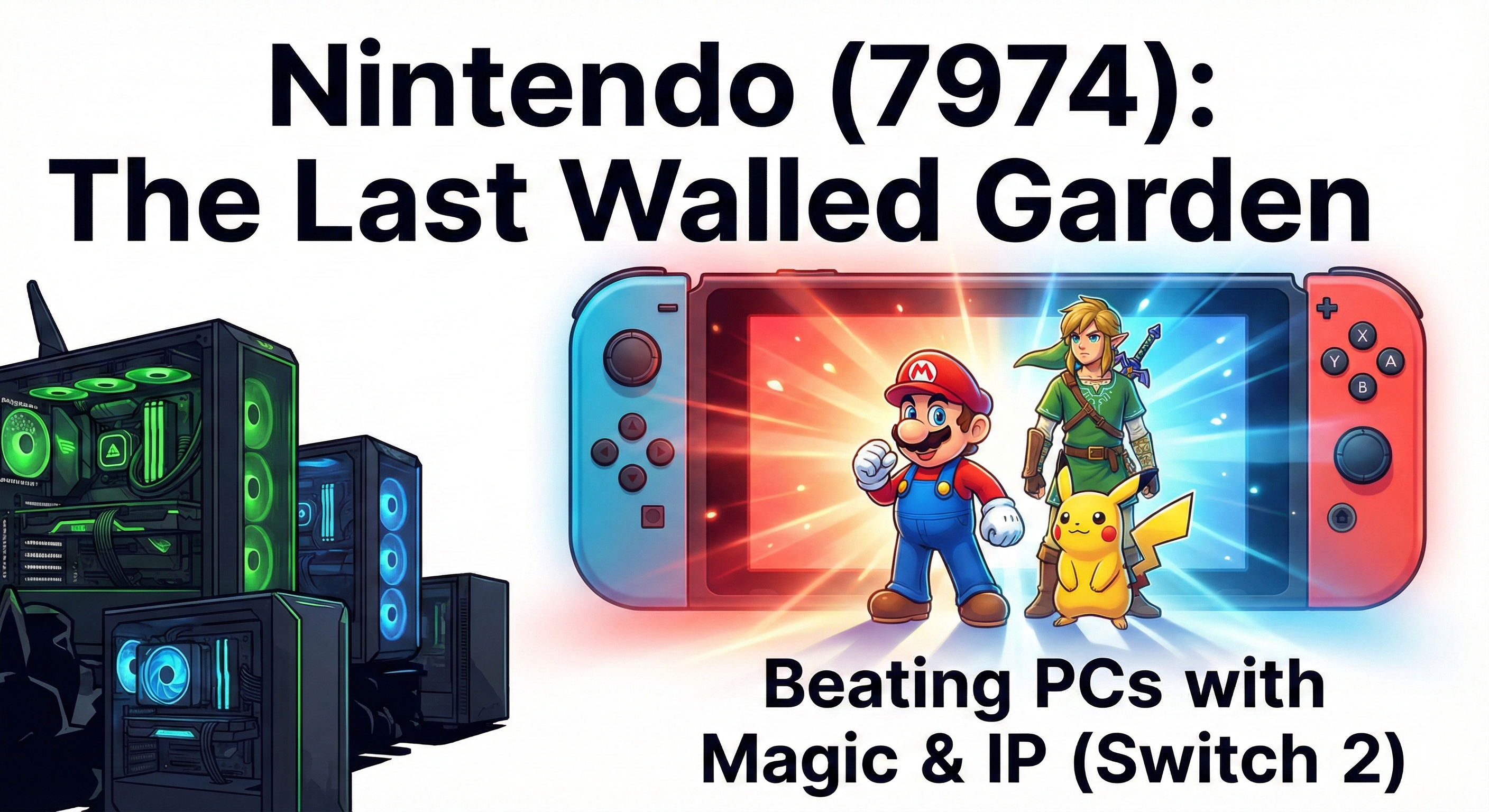
However, Nintendo defies this gravity. If you want to play Zelda, you must buy Nintendo hardware. Just as Apple created a high-margin ecosystem by integrating the iPhone and iOS, Nintendo protects its margins by refusing to unbundle its software. This “Walled Garden” strategy ensures they capture not just software sales, but the platform royalty fees for every game sold on their system.
International investors often ask: “Won’t high-performance Gaming PCs make consoles obsolete?” This view misunderstands the market segmentation.
PCs have a high barrier to entry. For a parent buying a gift, or a casual adult player, the PC is too complex and expensive. Nintendo holds the position of the “Default Standard.” It is the entry point for the entire industry. As long as price and simplicity matter, PCs are not a threat to Nintendo.
The force that compels people to buy the hardware is, of course, the IP (Intellectual Property). Mario and Zelda are obvious, but the critical piece is Pokémon.
Technically, The Pokémon Company is a separate entity (equity-method affiliate). However, for investors, “Pokémon = Nintendo” is the correct framework. Mainline Pokémon games are released exclusively on Nintendo hardware. The massive profits from these sales flow back to Nintendo.
Owning the platform for the highest-grossing media franchise in history (Pokémon) provides a safety net that no other hardware manufacturer enjoys. As long as the next Pokémon is on Nintendo, the hardware will sell.
Currently, Nintendo’s stock may seem quiet. The original Switch has peaked. But do not mistake this for stagnation. It is the “Calm Before the Storm.”
History (from Wii to Switch) proves that Nintendo’s stock performs best during the announcement and launch phase of a new cycle. With a user base of over 100 million people ready to upgrade, and pent-up demand for “higher fidelity Zelda/Pokémon,” the launch of the next-generation console (Switch 2) will trigger a massive replacement cycle.
While competitors burn billions in an endless war for higher graphics and processing speeds, Nintendo plays a different game. They win by focusing on Fun, IP, and Accessibility.
No matter how powerful PCs become, they cannot play Mario. In the investment landscape of 2026, holding the “Disney of Japan” before its next big product launch is one of the most logical plays available.
This article is for informational purposes only and does not constitute financial advice. Please conduct your own due diligence.